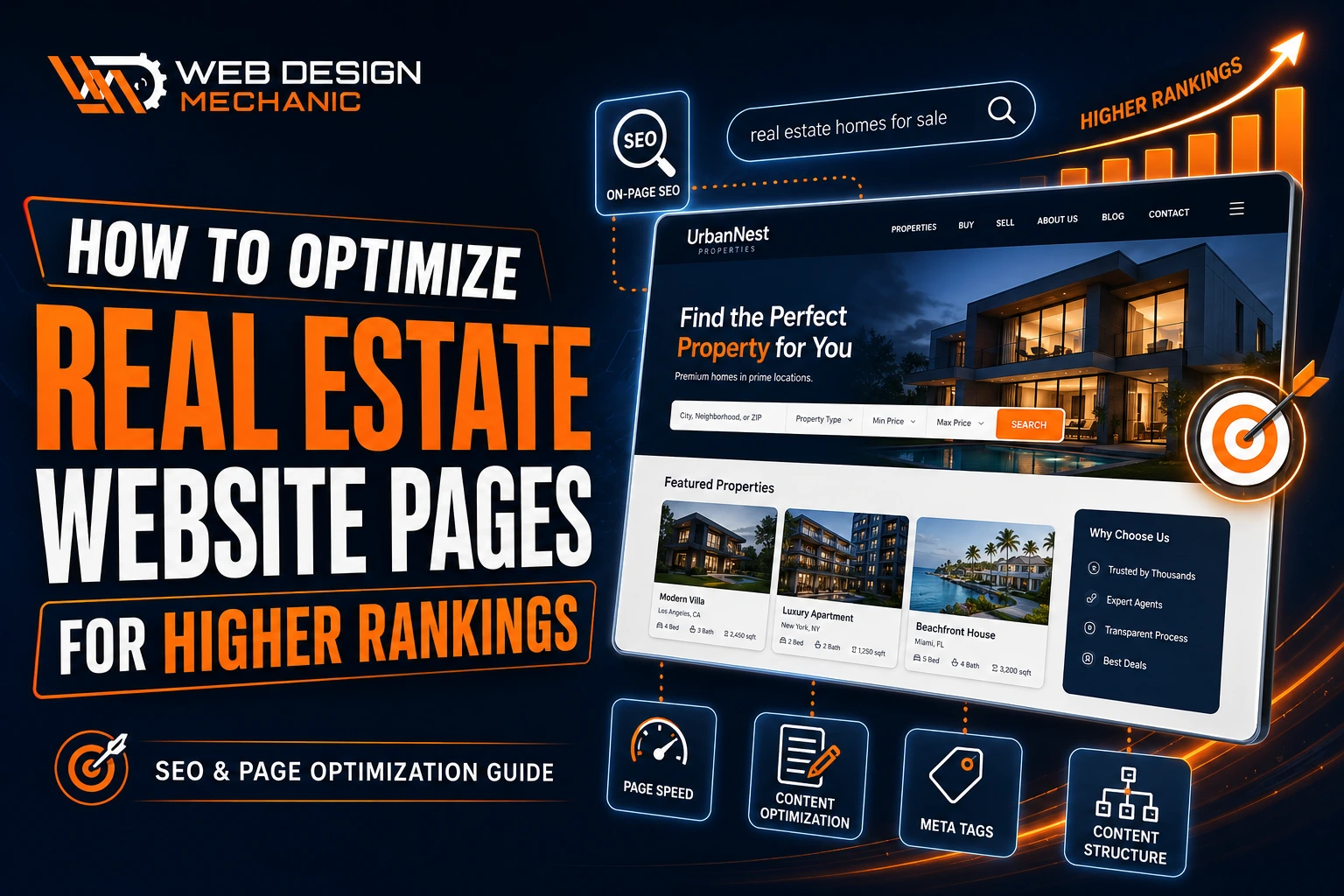

Think about the last time you went house hunting, not as an agent, but as a buyer. Where did you start? Most likely, it was a search engine. You typed in something like “homes for sale near me” or “3-bedroom house in [City Name].” In an instant, a list of websites appeared. Have you ever wondered why some agents always seem to be at the top of that list while others are buried on page ten? It isn’t magic, and it isn’t just about having a big budget. It is about mastering on-page SEO for real estate website performance.
If your website is the digital version of a home, then on-page SEO is the curb appeal, the floor plan, and the staged furniture all rolled into one. You can have the most beautiful listings in the world, but if search engines can’t find them, they might as well not exist.
In this guide, we’re going to walk through exactly how to optimize property listings for SEO, how to write perfect SEO titles for property listings, and how to structure your site so that Google falls in love with it.
If you are just starting your journey, you might want to look at How to Build a Real Estate Website That Generates Leads to ensure your foundation is solid before you start the fine-tuning.
What Exactly is On-Page SEO for Real Estate?
Before we dive into the technical details, let’s get on the same page. On-page SEO for real estate website optimization refers to the practice of individualizing each page on your site so that search engines can understand its content and relevance. This includes your homepage, your neighborhood guides, and, most importantly, your individual property listings.
When you focus on on-page SEO for real estate website health, you are essentially providing Google with a roadmap. You are telling the search engine, “This page is about a luxury condo in downtown Miami,” or “This page offers a free home valuation for sellers in Austin.” By being clear and organized, you make it easier for Google to recommend your site to potential clients.
A huge part of this process involves looking at Modern Real Estate Website Design Ideas for Better Conversions. A well-designed site isn’t just for looks; it’s built with an on-page SEO for real estate website strategy in mind, ensuring that both users and bots have a seamless experience.
Crafting High-Impact SEO Titles for Property Listings
The most important element of any page on your site is the title tag. This is the blue link that people see in the search results. If you want to optimize property listings for SEO, you cannot afford to have generic titles like “Listing 123” or “Property Page.”
Effective SEO titles for property listings should be descriptive, local, and enticing. Think about what a buyer is actually typing into the search bar. Instead of just the address, try including the key features. For example:
- Bad Title: 456 Oak Street
- Good Title: 4-Bedroom Modern Home for Sale at 456 Oak St, Dallas | [Your Brand]
By using specific SEO titles for property listings, you are signaling to Google that your page is a perfect match for someone looking for a “4-bedroom home in Dallas.” Remember, you only have about 60 characters before Google cuts off the text, so put the most important keywords at the beginning of your SEO titles for property listings.
Mastering the Meta Description with Real Estate Meta Tags Examples
While the title gets the attention, the meta description closes the deal. This is the short blurb below the title. While it doesn’t directly affect your rankings, it drastically affects your click-through rate. If you write compelling real estate meta tags examples, more people will click on your site, which indirectly tells Google that your page is relevant.
Here are a few real estate meta tags examples to get you started:
- Example 1 (For a Listing): “Explore this stunning 3-bedroom craftsman home in North Seattle. Featuring a chef’s kitchen, a private backyard, and top-rated schools nearby. Schedule your tour today!”
- Example 2 (For a Seller Page): “Wondering what your home is worth in San Diego? Get a free, instant home valuation based on recent neighborhood sales. Click to find out your property’s value now!”
When writing your own based on these real estate meta tags examples, make sure to include a call to action. Words like “Explore,” “Schedule,” or “Find out” encourage the user to click. These real estate meta tags examples prove that a little bit of creative copywriting goes a long way in your on-page SEO for real estate website strategy.
Why Real Estate Website URL Structure Matters
Have you ever looked at a web address and seen a long string of random numbers and symbols? It looks messy, right? It also confuses search engines. A clean real estate URL structure is vital for helping Google index your pages correctly.
When you optimize property listings for SEO, your URL should tell a story.
- Messy URL: yourrealty.com/p?id=98765-abc
- Clean URL: yourrealty.com/denver-homes/123-maple-street
A logical real estate URL structure helps Google understand the hierarchy of your site. It shows that the 123 Maple Street page belongs in the Denver Homes category. This organized real estate URL structure also makes your site appear more trustworthy to potential clients. They are much more likely to click on a link that clearly describes what they are about to see.
If you are hiring a professional to handle this for you, it is worth asking about their cost of real estate website development.
How to Optimize Property Listings for SEO
Most real estate websites just copy and paste the description from the MLS. This is a huge mistake. Google hates duplicate content. If you want to truly optimize property listings for SEO, you need to write unique, high-quality descriptions for your featured listings.
To optimize property listings for SEO, don’t just list the number of bathrooms. Talk about the neighborhood. Mention the nearest park, the vibe of the local coffee shops, and the commute times to major employment hubs. When you optimize property listings for SEO in this way, you are creating a resource that provides real value to the buyer.
Furthermore, use your keywords naturally within the description. Don’t force them. If you are trying to optimize property listings for SEO for a home in Phoenix, mention “living in Phoenix” or “Phoenix real estate market trends” once or twice. This is the heart of on-page SEO for real estate website success, being helpful while being searchable.
For those focusing on specific towns, don’t forget the importance of Local SEO for Real Estate Agents: How to Rank Higher in Your Area. Local authority and on-page SEO for real estate website tactics work hand-in-hand to dominate your specific market.
Strategic Internal Linking and Site Architecture
Internal linking is the practice of linking from one page on your site to another. This is a powerful part of on-page SEO for real estate website management. For example, if you are writing a blog post about the best schools in a neighborhood, you should link to your property search page for that specific area.
This helps Google understand the relationship between your pages. It also keeps visitors on your site longer. Every time a visitor clicks an internal link, they are moving deeper into your sales funnel. This is a key step in on-page SEO for real estate website growth because it reduces your bounce rate, a signal that Google uses to determine quality.
If you find this technical side overwhelming, don’t hesitate to visit our Contact Us page to discuss how a professional audit can help. Sometimes, just fixing your real estate URL structure and internal links can result in a quick ranking boost.
The Power of Image SEO
Real estate is a visual business. You have dozens, maybe hundreds, of high-resolution photos on your site. But search engines can’t see images; they can only read the text associated with them. To truly optimize property listings for SEO, you must optimize your images.
This involves two things:
- File Names: Instead of IMG_001.jpg, rename your file to modern-kitchen-dallas-home.jpg. This helps your photos show up in Google Image searches.
- Alt Text: This is a hidden description of the photo for screen readers and bots. A good alt text for a listing photo might be: “Spacious master bedroom with hardwood floors in a Dallas real estate listing.”
By including your keywords in image titles and alt text, you are adding another layer to your on-page SEO for a real estate website strategy. It’s a small detail that many agents ignore, giving you a competitive advantage when you optimize property listings for SEO.
Why You Need a Blog for Your Real Estate Website’s On-Page Success
While SEO titles for property listings are great for capturing buyers, a blog is how you capture everyone else. A blog allows you to target informational keywords that might not fit on a property page.
For instance, you can write about “How to stage your home for a quick sale” or “5 things to know before moving to [City Name].” These posts allow you to use more real estate meta tags examples and build your authority. Within these posts, you can link back to your listings, using a logical real estate URL structure to guide the user.
A blog is the “fuel” for your on-page SEO for a real estate website engine. It provides fresh content for Google to crawl and gives you more opportunities to appear in search results. Every blog post is a new opportunity to use SEO titles for property listings (for similar homes) and a clean real estate URL structure to rank for niche topics.
Technical Elements: Speed and Mobile-Friendliness
You can have the best real estate meta tags examples and a perfect real estate URL structure, but if your site takes ten seconds to load, you will fail. Page speed is a major ranking factor. Large, unoptimized images are the #1 reason real estate sites are slow.
Always compress your photos before uploading them. Use modern image formats like WebP. A fast site makes it easier for Google to index your SEO titles for property listings and rewards your on-page SEO for real estate website efforts.
Also, check your site on your phone! Most real estate searches now happen on mobile devices. If your real estate URL structure looks weird on mobile or if your SEO titles for property listings are cut off prematurely, you need to fix your responsive design.
The Long-Term ROI of Optimization
You might be thinking, “This sounds like a lot of work.” And you’re right. But the return on investment for on-page SEO for real estate website excellence is massive.
Unlike paid ads, which stop bringing in leads the moment you stop paying, a well-optimized page continues to work for you for years. When you optimize property listings for SEO and master your SEO titles for property listings, you are building “equity” in your website. Over time, your cost per lead drops significantly compared to agents who only rely on Zillow or Facebook ads.
Building a site with a great real estate URL structure and following these real estate meta tags examples is essentially like planting a garden. It takes some sweat equity at the beginning, but soon, you’ll be harvesting leads while you sleep.
How to Get Started Today
If your site is already live, start with your most important pages. Look at your top five listings. Do they have compelling SEO titles for property listings? Are the URLs clean, following a professional real estate URL structure? Do they follow the best real estate meta tags examples?
If you see room for improvement, start making changes. One page at a time, you can optimize property listings for SEO and improve your overall on-page SEO for a real estate website score.
If you are overwhelmed by the technical side, like setting up a complex real estate URL structure or writing hundreds of SEO titles for property listings, that’s where the pros come in. At Web Design Mechanic, we specialize in the behind-the-scenes work that makes your site a powerhouse. From real estate meta tags examples that convert to an on-page SEO for a real estate website plan that ranks, we handle the technology so you can handle the houses.
Make sure your digital home is just as impressive as the ones you sell in person. Take these tips, start optimizing, and watch your rankings and your commissions climb to new heights.
If you’re ready to take the next step and want to ensure every part of your site is optimized, from the real estate URL structure to the images, reach out to us. We’re here to help you turn your website into your most productive sales agent. Happy optimizing!