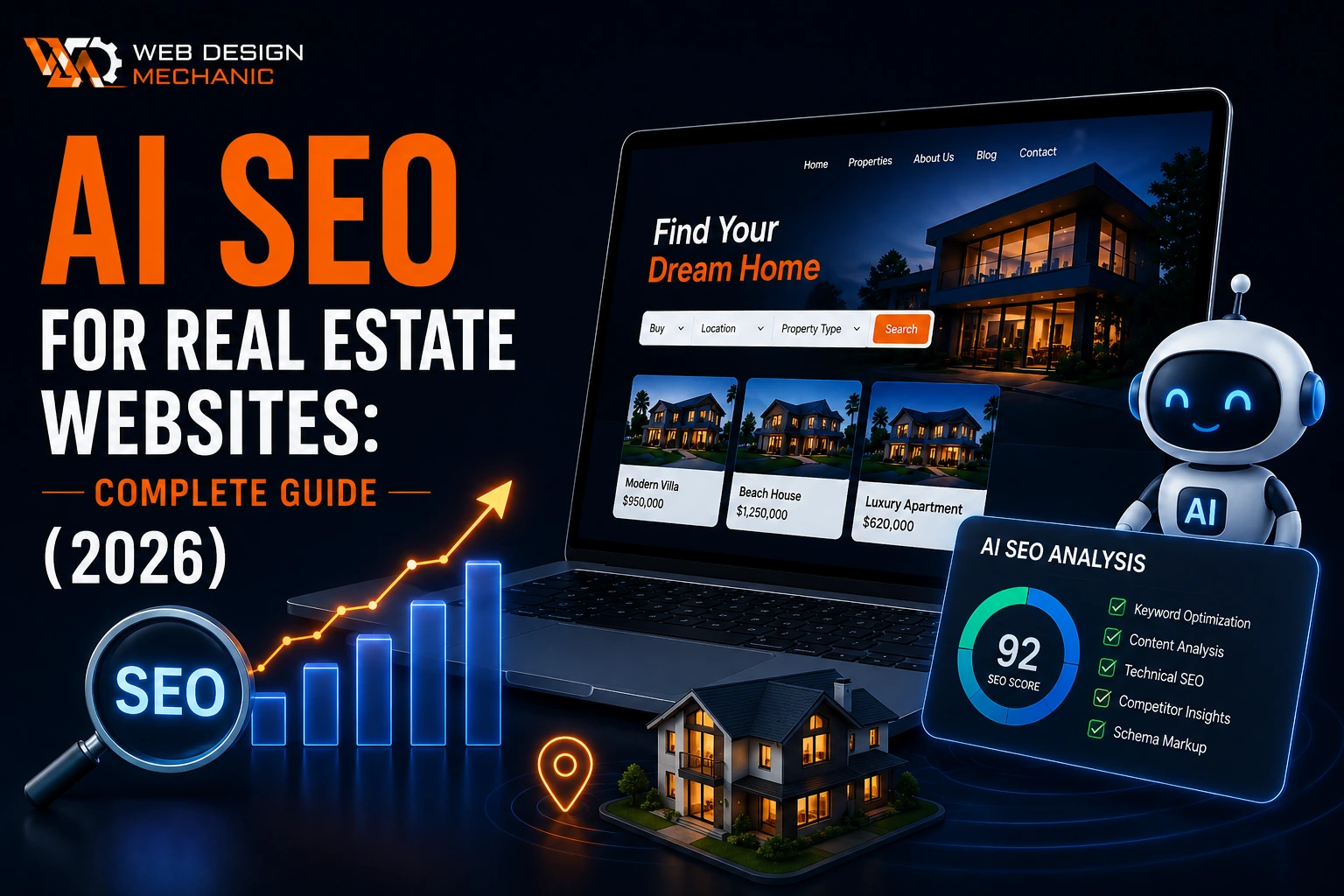

SEO in real estate has always been competitive. You’re fighting for visibility in markets where every click represents a potential commission, and the agencies and portals you’re up against have enormous resources. What’s changed heading into 2026 is that AI has dramatically shifted how SEO works, both in terms of how search engines rank content and how smart teams optimize for those rankings for AI SEO.
We’ve been deep in the weeds on AI SEO for real estate for some time now, and this guide is our attempt to give you a clear, practical picture of where things stand, what actually works, and how to build a strategy that positions your real estate website for sustained organic visibility.
What Is AI SEO for Real Estate, and Why Does It Matter in 2026?
AI SEO for real estate isn’t a single tool or tactic; it’s an approach that uses artificial intelligence across multiple aspects of your search engine optimization strategy. That includes how you research keywords, how you create content, how you analyze competitors, how you optimize technical performance, and how you measure results.
At the same time, Google and other search engines are themselves using AI (including their own large language models and ranking algorithms like RankBrain and MUM) to better understand search intent and evaluate content quality. This means the old keyword-stuffing playbooks don’t work, and generic, thin content is actively penalized.
For real estate websites, this is actually good news if you’re willing to do the work properly. High-quality, locally relevant, authoritative content has never been more rewarded.
How AI Is Changing Real Estate SEO Strategy
Understanding Search Intent More Deeply
AI tools can analyze the intent behind search queries far more effectively than manual research. A search for “homes for sale in [city]” usually signals that users want property listings. Queries such as “is [neighborhood] a good place to live” indicate they are looking for editorial or informational content. Meanwhile, people searching for “how to choose a real estate agent” are typically seeking practical guidance.
Matching your content to these distinct intents is critical. AI tools help identify the full landscape of intent around your target keywords so you can build a content strategy that covers the entire buyer and seller journey.
Predictive Keyword Research
Traditional keyword tools show you historical search volume. AI-powered keyword research tools can also identify emerging trends and keywords that are growing in search volume before they become highly competitive. For real estate, this means you can target neighborhoods, developments, or market conditions that are gaining attention before larger competitors catch on.
Content Creation and Optimization
AI writing tools can accelerate content production, but the key is using them strategically. In our view, the best approach is to use AI to assist with research, outlining, and optimization while keeping the actual writing human, authoritative, and specific to your market. Google’s quality rater guidelines and helpful content policies reward genuine expertise and local specificity, exactly the things that generic AI content struggles to provide.
Core Components of a Real Estate AI SEO Strategy
Technical SEO: The Foundation
No AI-powered content strategy will succeed on a technically broken website. Core technical SEO elements remain essential heading into 2026:
- Site speed:Google’s Core Web Vitals are still significant ranking factors. AI tools can help identify and prioritize technical improvements.
- Mobile optimization:Real estate searches are heavily mobile. Your site must perform flawlessly on every device.
- Structured data/schema markup:Implementing real estate-specific schema (property listings, agent profiles, local business) helps search engines understand your content and can improve how your pages appear in results.
- Crawlability:Ensure search engines can efficiently crawl and index your pages.
We cover the technical foundations in detail for those building or upgrading their sites; understanding the differences between WordPress and custom real estate website development is particularly relevant here because your platform choices directly affect your technical SEO flexibility.
Local SEO for Real Estate
Local search is where real estate businesses win or lose organically. “Homes for sale in [city],” “real estate agent in [neighborhood],” “best areas to live in [metro area]”, these are the high-intent queries that drive actual leads.
AI SEO tools for real estate help with local optimization by:
- Analyzing local SERP features (map packs, local knowledge panels)
- Identifying gaps in your local content coverage
- Monitoring local ranking fluctuations
- Helping create hyper-local content that targets specific neighborhoods
Our detailed guide on how to optimize real estate website pages for higher rankings is a solid companion resource for building out your local SEO pages correctly.
Content Architecture and Topic Clustering
One of the most impactful things AI can help with in real estate SEO is building a coherent content architecture. Rather than creating isolated blog posts, a modern AI SEO for real estate websites approach uses topic clustering: a comprehensive pillar page targeting a broad topic (like “buying a home in [city]”) supported by cluster content targeting specific subtopics (mortgage process, school districts, neighborhood guides, etc.).
AI tools can help map out these clusters systematically, identify gaps, and prioritize based on search demand and competition. The result is a website that signals deep topical authority to search engines, which is increasingly how rankings are earned in competitive markets.
On-Page Optimization at Scale
On-page SEO, optimizing title tags, meta descriptions, header structure, internal linking, and content depth, has always been important. AI makes it possible to audit and improve on-page elements across large sites more efficiently. AI tools can scan your existing pages, identify optimization opportunities, suggest improvements, and even help implement changes at scale.
For real estate websites with hundreds or thousands of listing pages, this kind of scale is invaluable. You can read more about our approach to this work through our real estate website design services, and if you’d like to explore how we can help with your specific situation, our contact page is the best starting point.
AI SEO Tools Worth Knowing in 2026
The tool landscape changes quickly, but some categories remain consistently useful for real estate SEO:
AI-powered keyword research: Tools that go beyond volume and show intent clusters, topical gaps, and emerging trends.
Content optimization platforms: These analyze top-ranking content for your target queries and identify what depth, structure, and semantically related terms your content needs to compete.
Technical SEO crawlers with AI analysis: Tools that not only identify technical issues but also prioritize fixes based on their expected impact on rankings.
Local rank tracking: Especially important for real estate, tracking rankings at the zip code or neighborhood level gives a much more accurate picture of local performance than city-level tracking.
Competitor intelligence: Understanding what’s driving competitor rankings (backlinks, content, technical factors) helps you identify the most efficient path to outranking them.
Content Strategy for Real Estate SEO in 2026
The content side of SEO for real estate websites in 2026 is where many agencies fall short. Here’s what a strong content strategy looks like:
Neighborhood and area guides: Detailed, locally specific content about the communities you serve. Not generic descriptions, but real insights, local market trends, school quality, lifestyle, and development activity.
Market reports: Regular updates on local market conditions. This kind of time-sensitive content builds authority and attracts return visitors.
Buyer and seller guides: Educational content that addresses specific stages of the transaction. First-time buyer guides, investment property analysis frameworks, seller’s checklists.
FAQ and long-tail content: AI helps identify the specific questions your target audience is asking. Creating content that directly answers these builds visibility for long-tail searches and positions you as a trusted resource.
Explore our guide on how to do SEO for a real estate website for a practical framework you can start applying immediately.
Measuring AI SEO Results for Real Estate
You can’t manage what you don’t measure. For real estate SEO, the metrics that matter most include:
- Organic traffic growth by page and keyword cluster
- Local ranking positions for target queries
- Conversion rate from organic traffic (contact forms, chatbot interactions, phone calls)
- Backlink growth and quality
- Core Web Vitals scores
AI analytics tools can process this data faster and surface insights more efficiently than manual analysis, helping you make faster, smarter decisions about where to focus your efforts.
Final Words
As search engines continue to evolve, AI SEO for real estate websites is becoming an essential strategy for improving online visibility and attracting qualified buyers and sellers. By combining intelligent automation with proven SEO practices, we can create content that aligns with search intent, optimize technical performance, and build a stronger local search presence without compromising quality.
Whether we’re using AI SEO real estate strategies for keyword research, content optimization, technical audits, or local SEO, the goal remains the same: helping our website rank higher while delivering a better experience for users. The right real estate SEO AI tools can streamline repetitive tasks, but human expertise is still crucial for creating valuable, trustworthy content that resonates with potential clients.
As we move further into SEO for real estate websites in 2026, businesses that embrace AI strategically will be better positioned to outperform competitors, adapt to changing search algorithms, and generate consistent organic traffic. By implementing search engine optimization AI for real estate thoughtfully, we can build a scalable SEO strategy that drives long-term growth and sustainable lead generation.