
In today’s digital-first market, your website isn’t just an online business card; it is your 24/7 storefront, your lead generator, and your brand ambassador. If you are currently in the process of learning how to build a real estate website that generates leads, you’ve probably realized that there is a big difference between a site that looks okay and a site that actually closes deals.
When potential clients land on your page, they are looking for more than just a phone number. They are looking for a seamless, informative, and high-tech experience. To provide that, you need to master the fundamental features of a real estate website that keep users engaged. Furthermore, you must understand how a logical real estate website structure helps both users and search engines navigate your content.
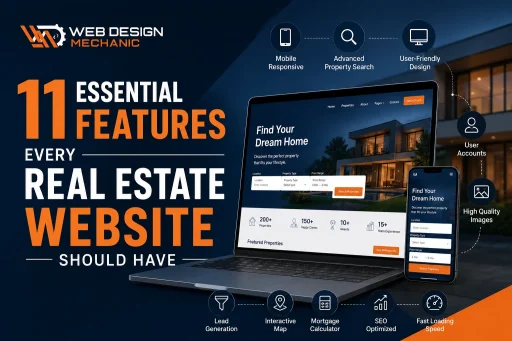
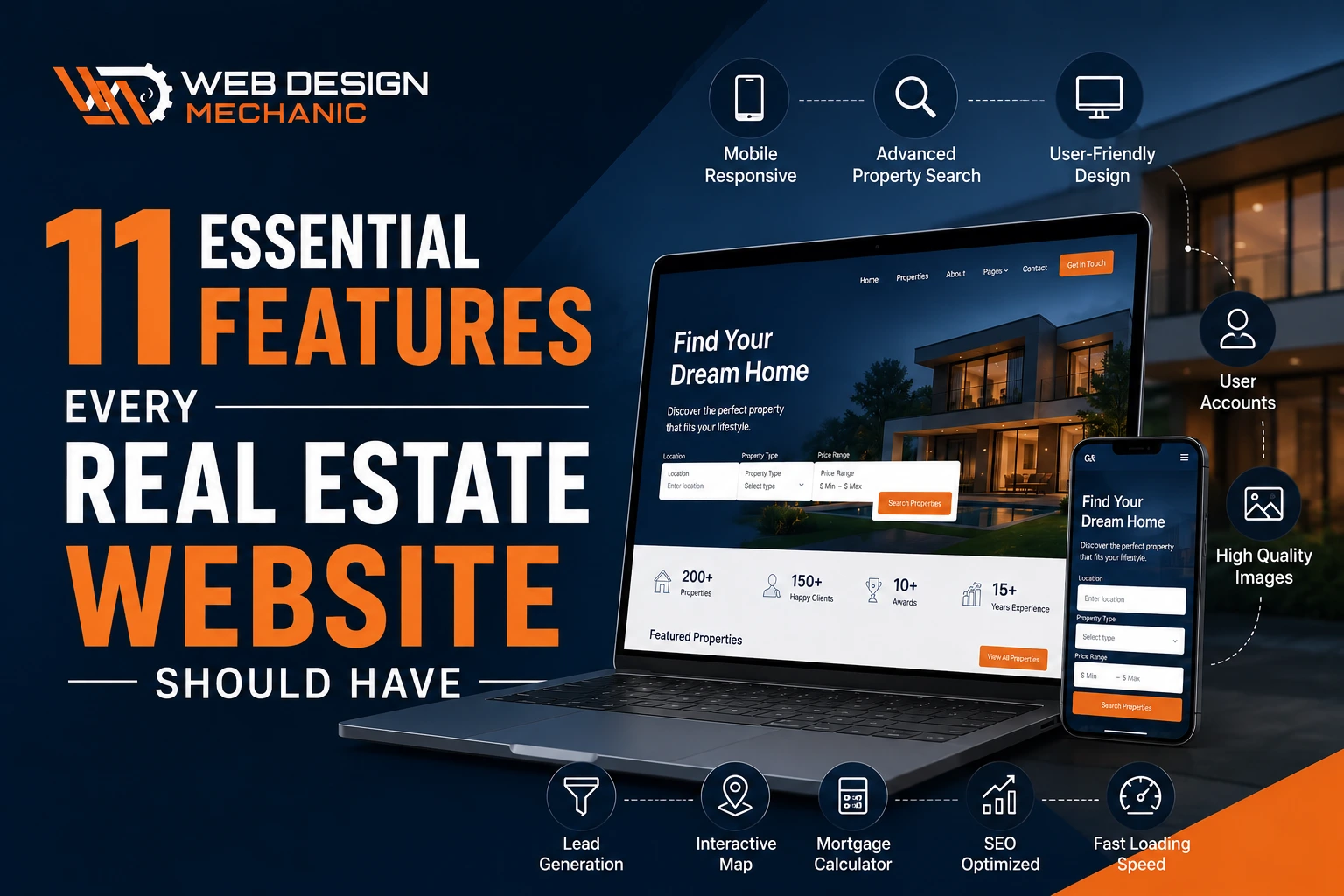
In this guide, we’ll explore the 11 essential features you need to succeed.
1. Advanced IDX Integration
The absolute heart of any modern real estate platform is the IDX (Internet Data Exchange). This is the technology that pulls live listings from the MLS (Multiple Listing Service) and displays them on your site. Without a robust IDX, your site is just a blog.
When considering the features of a real estate website, IDX is non-negotiable. It allows users to browse up-to-the-minute property data without leaving your domain. But don’t just settle for a basic link. You want an indexable IDX. This means every property listing becomes its own page on your site, which is a core component of a healthy real estate website structure. This helps you rank for specific property addresses on Google, bringing in organic traffic that most agents miss out on.
2. Mobile-First Responsive Design
Did you know that over 60% of real estate searches now happen on a mobile device? If your site looks great on a laptop but is a mess on an iPhone, you are losing more than half of your potential business.
A mobile-first design means your site is built specifically to be used with a thumb. Buttons should be easy to click, maps should be easy to pinch and zoom, and forms should be simple to fill out. When you study modern real estate website design ideas for better conversions, you’ll see that the best sites prioritize mobile speed and usability above all else. This responsive nature is a key part of any modern real estate website structure.
3. Advanced Property Search Filters
Users don’t just want to search by “City” and “Price.” They want to find their dream home, and that means specifics. Your search tool should be one of the most powerful features of a real estate website.
Give them the ability to filter by:
- School districts
- Property type (Condo, Single Family, Land)
- Specific amenities (Pool, Garage, Fireplace)
- Year built and days on market
By providing these granular filters, you keep users on your site longer, which reduces your bounce rate and signals to Google that your real estate website structure is providing high value to the community.
4. Interactive Maps and Neighborhood Location Data
Real estate is all about “Location, Location, Location.” An interactive map isn’t just a fancy toy; it’s a vital tool for buyers who want to know how far the house is from their job, the grocery store, or their favorite park.
Integrating a Google Maps API allows users to visualize the geography of their search. This is one of the most popular features of a real estate website because it adds a layer of interactivity. When you are planning your real estate website structure, ensure the map is prominent on both the search results page and the individual property detail pages.
5. High-Quality Visuals and Virtual Tours
In 2026, a few blurry photos from a smartphone won’t cut it. You need professional, high-resolution photography, drone footage, and, ideally, 3D virtual tours (like Matterport).
Visual content is what stops the scroll. If you’re looking for website design services to help you integrate these large media files without slowing down your site, Web Design Mechanic can help you optimize your media. High-quality visuals should be baked into your real estate website structure, ensuring that every listing page feels like a luxury experience. High-quality imagery is a cornerstone among the features of a real estate website that actually drive conversions.
6. Strategic Lead Capture and Call-to-Actions (CTAs)
Your website’s primary job is to get you the lead’s contact information. To do this, you need a mix of “Soft” and “Hard” CTAs.
- Hard CTA: “Schedule a Private Showing” (Found on listing pages).
- Soft CTA: “Download our First-Time Homebuyer’s Guide” (Found on blog posts).
A well-organized real estate website structure places these CTAs where the user is most likely to click. Don’t hide your contact form on a single “Contact Us” page. Place lead capture forms on every listing, every neighborhood guide, and in your sidebar. These are the features of a real estate website that turn traffic into commissions.
7. Integrated CRM and Lead Management
What happens when someone fills out a form on your site? If that info just goes to your email inbox and sits there, you’ve already lost. A lead-generating real estate website structure must be connected to a CRM (Customer Relationship Management) tool.
Systems like Follow Up Boss, LionDesk, or KVCORE allow you to instantly text or email the lead. Speed to lead is the #1 factor in closing digital deals. When researching the features of a real estate website, always ask if the platform can “talk” to your CRM. This automation is a major factor when determining how much a real estate website cost in 2026.
8. Hyper-Local Neighborhood Guides
Google loves local content. To compete with Zillow, you need to provide information that a giant algorithm can’t: local expertise. Creating dedicated pages for neighborhoods, school districts, and local lifestyles is a brilliant way to expand your real estate website structure.
Tell the user about the best coffee shops, the hidden parks, and the vibe of the area. These guides are essential features of a real estate website because they build trust. They prove to the user (and to Google) that you are the true local authority.
9. Mortgage and Affordability Calculators
Before a buyer falls in love with a house, they need to know if they can afford it. Including a mortgage calculator is one of the most practical features of a real estate website.
It keeps users engaged with your site during the financial planning phase of their journey. A well-placed calculator within your real estate website structure, perhaps right below the property price, encourages users to spend more time on your domain, which is great for your SEO rankings.
10. Social Proof and Client Testimonials
In real estate, trust is the only currency that matters. You need a dedicated space in your real estate website structure for testimonials, reviews, and sold stories.
Don’t just use text; use video testimonials if you can. Seeing a happy family in front of their new home with your “Sold” sign is the most powerful marketing you can have. These are the features of a real estate website that humanize your brand and make you approachable.
11. Lightning-Fast Loading Speed
This is the most technical of the features of a real estate website, but it’s also the most important. If your site takes more than 3 seconds to load, 40% of people will leave.
Site speed is a major ranking factor for Google. When building your real estate website structure, you must ensure that your code is clean and your images are compressed. If your site feels sluggish, it doesn’t matter how pretty the design is; no one will stay long enough to see it.
Mastering the Real Estate Website Structure
Now that we’ve discussed the “what,” let’s talk about the “how.” The real estate website structure is the skeleton that holds everything together. If the skeleton is crooked, the whole house will eventually fall.
A logical real estate website structure usually looks like this:
- Homepage: The “Lobby” that directs users to search, sell, or learn.
- Search Results Page: The “Engine” where users filter listings.
- Property Detail Pages: The “Showroom” where you sell the specific home.
- Neighborhood Pages: The “Community” area that builds local SEO.
- The Blog: The “Education” hub for market news and tips.
- About/Contact: The “Trust” center.
When these components are linked together intelligently, you create a “silo” effect. For example, your blog post about “Living in Austin” should link to your “Austin Neighborhood Guide,” which should then link to your “Austin Homes for Sale” search page. This interlinking is a critical part of a high-performance real estate website structure.
Why These Features of a Real Estate Website Matter for Your ROI
You might be wondering if you really need all 11 of these. Can’t you just have a nice-looking site with a few photos?
The reality of the 2026 market is that the features of a real estate website are what justify your commission in the eyes of the consumer. When you provide a high-tech search experience, detailed local data, and instant communication tools, you are demonstrating your value.
Furthermore, these features of a real estate website work together to improve your SEO. Google measures “Dwell Time” (how long someone stays on your site). If you have a map to play with, a calculator to use, and videos to watch, your dwell time will be high. This tells Google that your real estate website structure is high-quality, which leads to higher rankings and more free leads.
For those concerned about the investment, Web Design Mechanic offers specialized services to ensure these features of a real estate website are implemented without breaking the bank. Understanding the balance between cost and functionality is key to a high ROI.
The Role of Design in Conversion
While we’ve focused on functionality, we cannot ignore aesthetics. The modern real estate website design ideas for better conversions all share one thing in common: Simplicity.
A modern real estate website structure should be minimalist. Don’t overwhelm the user with twenty different pop-ups and flashing buttons. Use high-quality typography, plenty of white space, and a cohesive color palette. The best features of a real estate website are the ones that work so smoothly that the user doesn’t even notice them.
Think about the “User Flow.” When a visitor lands on your home page, where do you want them to go? Most likely, you want them to search for homes. So, the search bar should be the biggest, most obvious thing they see. This is the essence of a conversion-focused real estate website structure.
Common Mistakes to Avoid in Your Real Estate Website Structure
Even with the best intentions, it’s easy to mess up the real estate website structure. Here are a few “don’ts”:
- Don’t use iFrames for IDX: This is an old way of showing listings that Google can’t read. It ruins your SEO.
- Don’t hide your phone number: People want to know you are reachable. Put your number in the header and the footer of every page.
- Don’t ignore the “Sold” listings: Showing that you actually sell homes is one of the most persuasive features of a real estate website.
- Don’t use generic stock photos: If people see the same stock photo of a “happy family” on five different realtor sites, they lose trust. Use real photos of your city and your clients.
Technical Maintenance: Keeping the Features of a Real Estate Website Running
Building the site is only half the battle. You also have to maintain it. Real estate data changes every minute. Listings are added, prices are dropped, and homes are sold. Your real estate website structure needs to be able to handle this constant data refresh without crashing.
This is why choosing the right hosting and platform is so important. Ongoing maintenance ensures that the features of a real estate website, like the mortgage calculator and the map, don’t break over time.
Summary
To wrap up, a successful real estate presence is built on two pillars: a rock-solid real estate website structure and a carefully curated set of features of a real estate website.
You need the technical power of IDX and fast load speeds, but you also need the “human” elements like testimonials and neighborhood guides. When you combine these 11 essential features, you aren’t just making a website; you are building a lead-generating machine that will grow your business for years to come.
If you are ready to start building, remember that you don’t have to do it alone. Expert website design services help you navigate the complexities of IDX, SEO, and UI/UX design.
Quick Checklist of the 11 Real Estate Website Features:
- IDX Integration (For live listings)
- Mobile Responsive (For users on the go)
- Advanced Search (For finding specific homes)
- Interactive Maps (For location context)
- High-Quality Visuals (For stopping the scroll)
- Clear CTAs (For capturing leads)
- CRM Integration (For fast follow-up)
- Local Guides (For SEO authority)
- Mortgage Calculator (For financial planning)
- Testimonials (For building trust)
- Site Speed (For keeping users on the page)
By mastering these features of a real estate website and keeping a logical real estate website structure at the forefront of your strategy, you’ll be well on your way to digital dominance in the real estate world.
Whether you’re an individual agent or a large brokerage, the principles remain the same. The internet is the new curb appeal. Make sure your digital home is just as inviting, functional, and impressive as the houses you sell.
Now, take this list and compare it to your current site. Where are the gaps? What can you improve? The journey to more leads starts with a single update. Happy building!