
If you’ve ever looked at how large property portals dominate search results across thousands of location-specific queries simultaneously, you’ve witnessed programmatic SEO in action, even if you didn’t know what to call it. The concept isn’t new, but AI has made it dramatically more accessible and powerful, particularly for independent real estate agencies and agents who want to compete at scale without a team of fifty content writers.
We’re going to break down exactly what programmatic SEO is, how AI makes it practical for real estate websites, and how to build a strategy that generates meaningful search visibility across dozens or hundreds of targeted queries, without sacrificing content quality.
What Is Programmatic SEO for Real Estate?
Programmatic SEO for real estate is the practice of automatically generating large numbers of optimized web pages based on templates and data, targeting high-intent, location-specific search queries at scale. Instead of manually writing individual pages for every neighborhood, city, property type, or buying scenario, you build a system that produces those pages systematically.
Think about queries like:
- “Condos for sale in [neighborhood name]”
- “Average home price in [city] 2026”
- “Best neighborhoods for families in [metro area]”
- “Investment properties under [price point] in [region]”
There are potentially thousands of variations of these queries across your target market. Manually creating a quality page for each one is impractical. Programmatically, with the right data and AI-powered systems, it becomes achievable.
Why Real Estate Is Perfectly Suited for Programmatic SEO
Real estate has a few characteristics that make it an ideal candidate for programmatic approaches:
Structured data availability: Property data, addresses, prices, square footage, bedroom counts, and neighborhood attributes are inherently structured. That makes it easy to pull into templates dynamically.
Predictable query patterns: Real estate searches follow recognizable patterns. “[Property type] for sale in [location]” is one of the most consistent search patterns across any industry.
Geographic scale: Even a regional agency might serve dozens of neighborhoods, multiple cities, and various property types. That creates a natural matrix of page opportunities.
High commercial intent: Someone searching “[neighborhood] homes for sale” is actively in the market. These pages aren’t just traffic; they’re lead opportunities.
How AI Powers Real Estate Programmatic SEO
Automated Content Generation That Doesn’t Feel Automated
The biggest challenge with programmatic SEO is avoiding what Google calls “automatically generated content” that’s thin, repetitive, or provides no genuine value. This is where AI changes the game for real estate SEO automation.
Modern AI can generate content variations that are genuinely useful and distinct from one another, pulling in local market data, neighborhood characteristics, school information, transit accessibility, and more to create pages that feel researched and specific rather than templated and generic.
The key is building your templates with enough dynamic data inputs that each page is meaningfully different. A page for a waterfront neighborhood should talk about waterfront lifestyle, local marina facilities, and premium pricing dynamics, not just swap out the location name from a generic template.
Data Enrichment and Local Intelligence
AI tools can aggregate and organize local data from multiple sources-, census data, school ratings, walkability scores, local business density, transit options- and feed that into your page templates automatically. This enrichment is what transforms a basic programmatic page into a genuinely useful resource that visitors (and search engines) actually value.
For example, a neighborhood landing page that includes dynamically updated median home prices, average days on market, and a breakdown of property types creates real value. An AI system can pull, format, and surface that data at scale across every neighborhood page on your site.
Identifying Page Opportunities at Scale
Before you build, you need to identify which pages to create. AI-powered SEO tools can analyze search data across your target geography and identify hundreds or thousands of valid page opportunities, ranked by search volume, competition, and commercial intent, faster than any manual process.
This is where scalable SEO for real estate websites becomes genuinely achievable. Instead of guessing which location pages to build, you’re working from a data-driven map of opportunity.
Building a Programmatic SEO System for Your Real Estate Website
Here’s the practical framework we use and recommend:
Step 1: Define Your Page Types
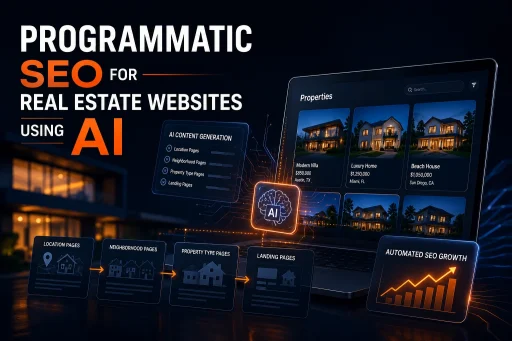
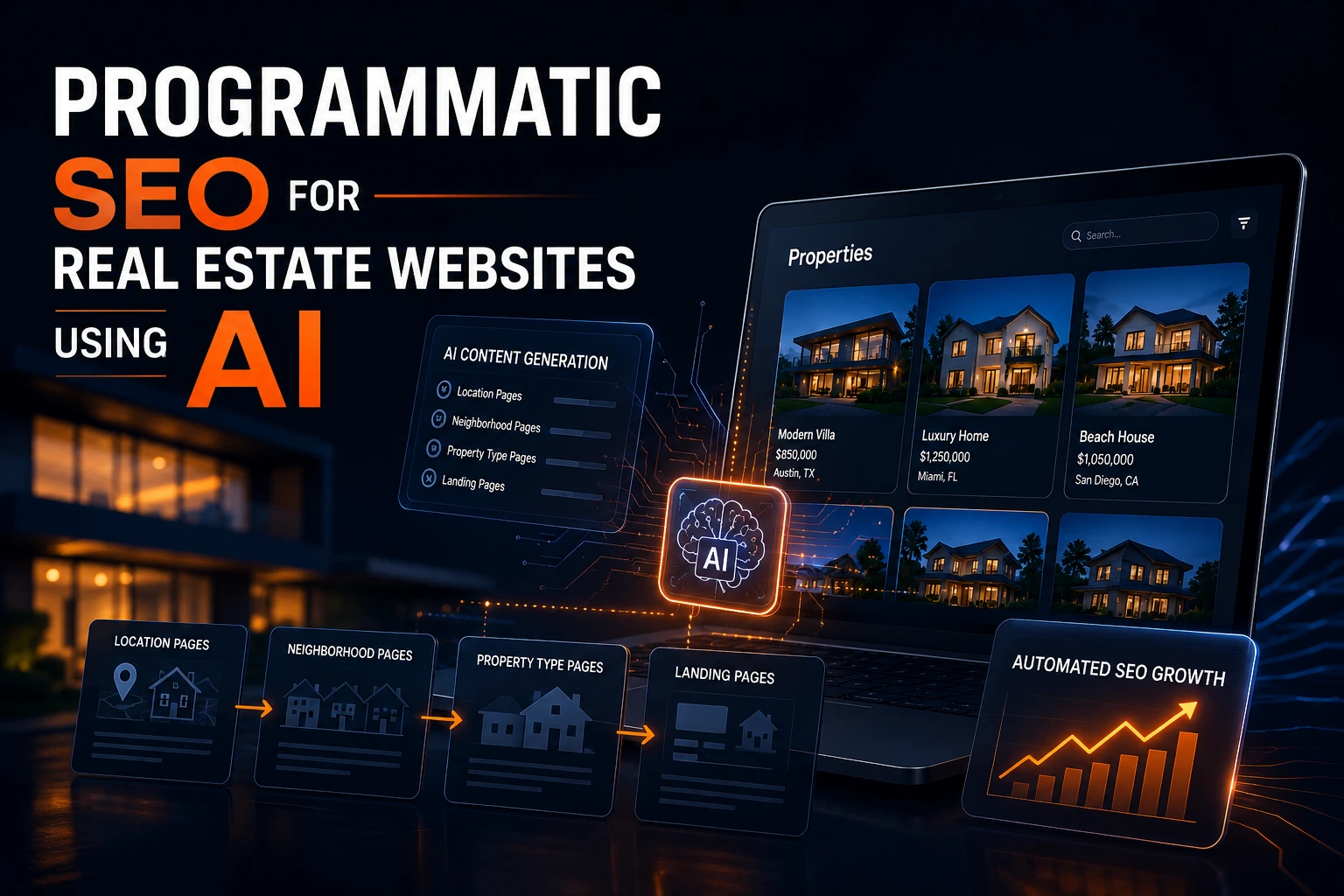
Start by identifying the categories of pages your system will generate. Common templates for real estate include:
- City/suburb pages: Targeting “[city/suburb] homes for sale” type queries
- Neighborhood pages: More specific than city-level, targeting hyperlocal queries
- Property type pages: “Condos in [city],” “townhomes in [area],” etc.
- Price bracket pages: “Homes under [price] in [city]”
- Feature-specific pages: “Homes with pools in [area],” “new construction in [neighborhood]”
Each of these is a template type. Each template has a consistent structure but varies based on the data fed into it.
Step 2: Build Your Data Infrastructure
Your pages are only as good as your data. At minimum, you need:
- MLS/listing data (updated regularly)
- Geographic boundary data (neighborhood polygons)
- Local amenity data
- Market statistics (median prices, sales velocity, inventory levels)
AI tools can help clean, standardize, and enrich this data, particularly when you’re pulling from multiple sources.
Step 3: Develop Your Templates
Each template needs a consistent structure that includes the key SEO elements (H1 with target keyword, meta title and description, header hierarchy, internal links) while allowing enough dynamic content to make each page genuinely unique.
This is where working with experienced developers matters. The website design and development approach you take directly affects how flexible and maintainable your templates are. Getting the technical architecture right from the start prevents significant rework later.
If you’re thinking through the investment involved, our breakdown of real estate website costs can help you set realistic expectations for a programmatic SEO build.
Step 4: Internal Linking at Scale
One of the most important and often overlooked aspects of real estate programmatic SEO is internal linking. With hundreds or thousands of pages, you need a systematic approach to connecting them. AI can help generate and maintain internal link structures, connecting neighborhood pages to city pages, city pages to region pages, and all of them to relevant listing pages and blog content.
Well-executed internal linking distributes page authority across your site and helps search engines understand the relationship between your pages. For local SEO specifically, this hierarchy of city → neighborhood → property type → individual listing creates a logical structure that search engines reward.
For deeper insights on local SEO strategy, our guide on local SEO for real estate agents covers the foundational principles that underpin any programmatic local approach.
Step 5: Quality Control and Monitoring
Launching hundreds of pages doesn’t mean launching hundreds of problems. Build quality control into your system from the start:
- Duplicate content detection: Use AI tools to flag pages that are too similar to each other or to existing content.
- Thin content alerts: Set thresholds for minimum content length and richness; pages that fall below should be flagged for review or consolidation.
- Performance monitoring: Track which pages are gaining traction and which aren’t performing. This informs both template refinement and data enrichment priorities.
Combining Programmatic SEO With Manual Content
The most effective AI programmatic SEO for real estate websites strategies don’t rely solely on automated pages. The best approach combines:
Programmatic pages for scale and coverage, capturing long-tail, location-specific queries across your entire market.
Editorial content for authority and depth, in-depth guides, market analyses, and neighborhood spotlights written with genuine expertise.
The programmatic pages attract traffic and build topical coverage. The editorial content builds E-E-A-T signals (Experience, Expertise, Authoritativeness, and Trustworthiness) that lift the authority of the entire site.
You can see examples of what strong editorial real estate content looks like in our modern real estate website design ideas guide, which also touches on how visual and content design work together.
Common Pitfalls in Real Estate Programmatic SEO
Thin pages with no real value: Swapping out location names without adding genuine local content gets pages de-indexed, not ranked. Every page must offer something specific and useful.
Ignoring the mobile experience: Programmatically generated pages still need to be visually clean and easy to navigate on mobile devices. Template design matters as much as content.
Not updating data: A neighborhood page showing outdated median prices or stale listing data is worse than no page at all. Build automated data refresh into your system.
Launching too fast: Rolling out thousands of pages at once without monitoring can cause crawl budget issues and trigger spam signals. Phase your launches and monitor crawl behavior.
Neglecting conversion: Programmatic pages that rank but don’t convert are incomplete. Every page should have clear CTAs, easy access to related listings, and ideally a contact or chat option. Web Design Mechanic gives a clear example of how strong conversion-focused design looks in practice.
Is Programmatic SEO Right for Your Real Estate Business?
It depends on your scale and ambitions. If you serve a single neighborhood and have a small listing inventory, traditional content creation is probably more appropriate. But if you cover multiple cities, serve diverse buyer segments, or want to build a competitive moat through search visibility across your entire market, programmatic SEO is one of the most powerful tools available.
We’d recommend reaching out to discuss your specific situation. Every market and business is different, and a strategy that works brilliantly in one context needs adjustment in another. Contact us to start that conversation.
Bottom Line
As competition in the property market grows, programmatic SEO for real estate offers a scalable way to expand organic visibility without sacrificing quality. By combining AI with a well-planned SEO strategy, we can efficiently create and optimize location-specific, property-type, and community pages that match what users are actively searching for.
Implementing AI programmatic SEO websites strategies allows us to automate repetitive SEO tasks while maintaining consistency across hundreds or even thousands of pages. When paired with unique, valuable content and strong technical optimization, real estate programmatic SEO helps improve search rankings, attract qualified traffic, and support long-term growth.
The key to success is using AI as a tool rather than a replacement for human expertise. With the right balance of automation, quality control, and user-focused content, scalable SEO for real estate websites becomes a powerful approach to reaching more buyers and sellers. By investing in real estate SEO automation, we can build a sustainable SEO foundation that continues to drive traffic, leads, and conversions well into the future.