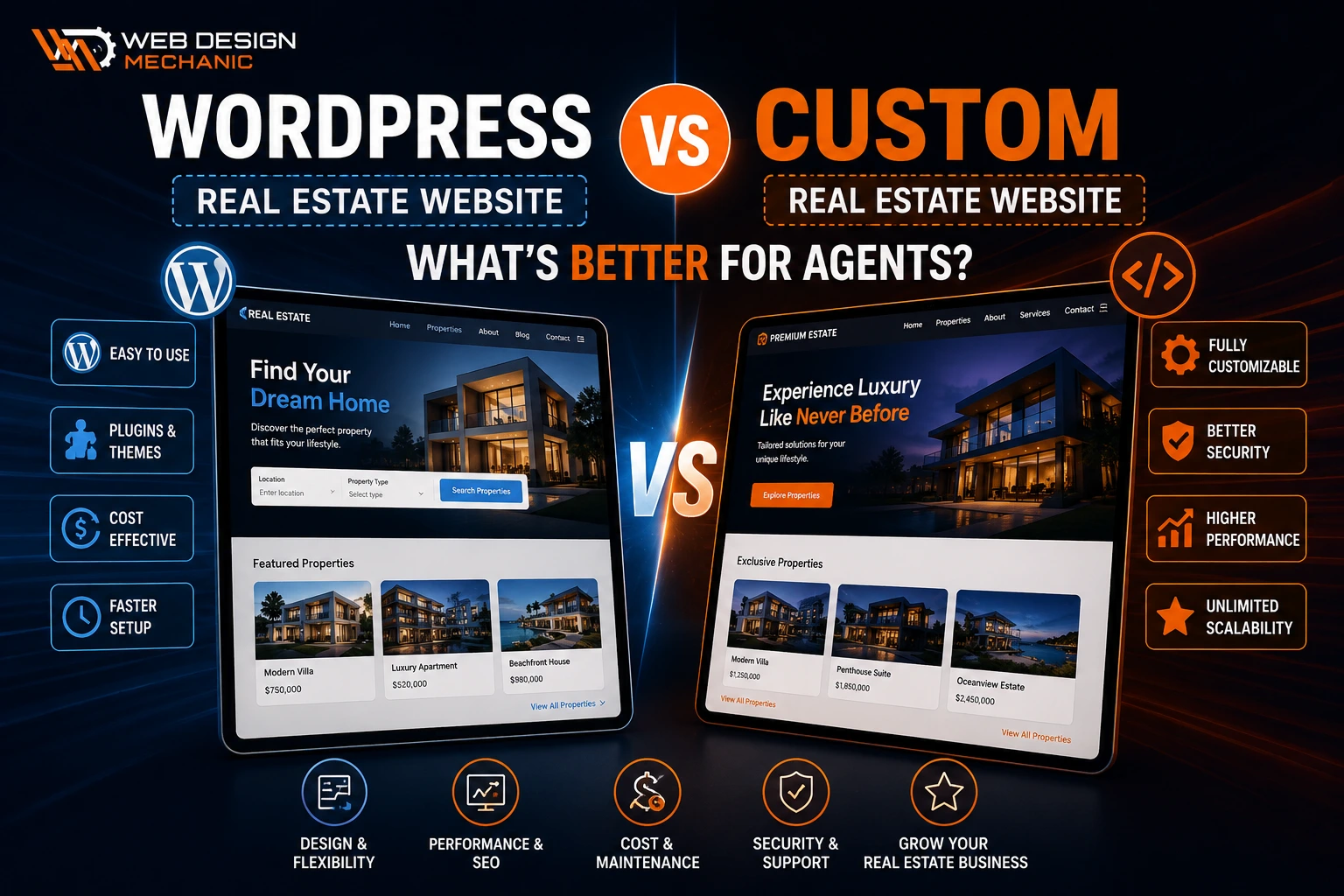

If you are an agent looking to establish a dominant online presence, you’ve likely found yourself at a crossroads. On one hand, you hear everyone talking about how easy it is to set up a site using a template. On the other hand, high-producing brokers swear by their proprietary, hand-coded platforms. It’s the classic debate: should you go with a WordPress real estate website or invest in custom real estate website development?
Your website is essentially your digital storefront. It’s where potential sellers go to vet your expertise and where buyers hunt for their dream homes. Choosing the wrong foundation can lead to slow load times, poor search engine rankings, and a frustrating user experience that drives leads straight into the arms of your competitors. When you start looking at a real estate website platform comparison, you aren’t just looking at prices; you’re looking at the future scalability of your business.
Choosing the best platform for a real estate website isn’t a one-size-fits-all answer. It depends on your budget, your technical comfort level, and how much unique functionality you need to stand out.
Let’s break down the pros and cons of both paths to help you make an informed decision for your brand.
Why Real Estate Professionals Choose WordPress
WordPress powers over 40% of the entire internet. It’s a massive ecosystem, and for many agents, a WordPress real estate website is the perfect entry point. The primary reason it’s so popular is the balance between ease of use and flexibility. You don’t need to be a coding wizard to get a site up and running.
One of the biggest perks of this platform is the availability of plugins. Whether you need to integrate an IDX feed, add a mortgage calculator, or set up a live chat feature, there is likely a plugin ready to go. However, this flexibility can be a double-edged sword. If you overload your site with too many extras, it can become sluggish.
If you’re leaning toward this route, it’s worth thinking about the visual side of things. You can find some incredible modern real estate website design ideas that show how far the platform has come. It’s no longer just for bloggers; it’s a robust tool for property listings and lead capture.
Why Agents Love WordPress:
- Cost-Effective: Generally cheaper to launch initially.
- User-Friendly: Easy to update your own blog posts or team bios.
- SEO Ready: Tools like Yoast SEO make it simple to rank for local keywords.
- Community Support: Thousands of developers know how to fix WordPress issues.
Stepping Up with Custom Real Estate Website Development
While WordPress is a one-size-fits-most solution, custom real estate website development is like having a suit tailored specifically for you. A custom site is built from the ground up, meaning there is no bloatware or unnecessary code slowing things down. Everything, from the search filters to the lead forms, is designed to work exactly how you want it to.
For agents who have a specific niche, perhaps luxury ranch properties or high-rise condos, a custom build allows for unique search parameters that standard plugins might not offer. In this real estate website platform comparison, custom development wins on performance and security. Because the code isn’t open-source, it’s often less vulnerable to the common bot attacks that plague popular platforms.
When you learn how to build a real estate website from scratch, you realize the level of control you gain. You can optimize for lightning-fast speeds, which is a massive ranking factor for Google. According to PageSpeed Insights, even a one-second delay in mobile load times can impact conversion rates by up to 20%.
Why High-Earners Choose Custom:
- Unmatched Performance: Faster load speeds and smoother transitions.
- Complete Ownership: You own every line of code, not just the content.
- Scalability: You can add complex features as your brokerage grows.
- Brand Distinction: No one else will have a site that looks or feels like yours.
Real Estate Website Platform Comparison: Feature by Feature
To really decide what’s best, we need to look at how these options stack up in the trenches of day-to-day real estate marketing. Choosing the best platform for a real estate website requires looking at long-term maintenance just as much as the initial launch.
1. Speed and User Experience
A WordPress real estate website can be fast, but it requires a lot of technical massaging and high-end hosting. On the other hand, custom real estate website development starts with speed as a priority. In a world where users are used to the snap-fast response of apps like Zillow, speed is a non-negotiable feature.
2. Search Engine Optimization (SEO)
WordPress is famous for being SEO-friendly right out of the box. However, a custom site can be “schema-optimized” in a way that helps Google understand your listings even better. When you look at a real estate website platform comparison, WordPress is great for the average user, but custom builds are for those who want to dominate the most competitive local keywords.
3. Maintenance and Security
WordPress requires regular updates for themes, plugins, and the core software. If you ignore these, your site can break or become a target for hackers. Custom sites require less frequent platform updates but might need a developer on call if you want to change something fundamental.
Finding the Best Platform for a Real Estate Website
So, how do you choose? The best platform for a real estate website is the one that aligns with your three-year plan. If you are an individual agent just starting out, the cost and speed of a WordPress real estate website are hard to beat. It allows you to get into the game quickly and start generating leads without a $10,000+ upfront investment.
However, if you are a team leader or a boutique brokerage owner, custom real estate website development is the better long-term play. It allows you to build a unique asset that adds value to your business. When people see a high-end, custom-built site, they immediately associate that quality with your service level.
If you find yourself stuck, it helps to consult with experts who understand the nuances of website design for the property industry. They can look at your specific goals and tell you which path will offer the highest return on investment.
The Cost Reality: Upfront vs. Long-Term
Money is always a factor. In any real estate website platform comparison, the price tag is usually the first thing agents look at. A WordPress real estate website might cost you anywhere from $2,000 to $5,000 for a professional setup. This usually includes a premium theme, IDX integration, and some basic SEO.
Conversely, custom real estate website development can range from $10,000 to $50,000 or more, depending on the complexity of the search algorithms and the number of custom integrations. It’s a significant jump. If you are curious about the specifics, reading about how much a real estate website costs can give you a clearer breakdown of where that money actually goes.
Integrating IDX: The Lifeblood of Your Site
No matter which platform you choose, your site is useless without property data. This is where the best platform for a real estate website must excel. WordPress uses plugins like IDX Broker or Showcase IDX to pull data from the MLS. These are great because they are easy to install, but they can sometimes look like a “framed” window that doesn’t perfectly match your site’s design.
With custom real estate website development, you can use an API to pull MLS data directly into your site’s database. This means the listings aren’t just “showing up” on your site; they are actually part of your site. This is huge for SEO because Google sees all those thousands of property pages as part of your domain.
Must-Have Features for Every Platform
Whether you go custom or WordPress, there are certain things you simply cannot skip. In our real estate website platform comparison, both options should support:
- Mobile-First Design: Most people search for homes on their phones while sitting in their cars.
- Lead Capture Forms: Pop-ups, contact buttons, and “What’s my home worth?” tools.
- Local Neighborhood Guides: Content that shows you know the area better than a national portal.
- High-Quality Visuals: Support for 4K video walkthroughs and 3D tours.
If you aren’t sure what to prioritize, a look at essential real estate website features will keep you focused on what actually converts visitors into clients.
Content Management: The “Agent” Factor
You are busy. You are out showing houses, negotiating contracts, and attending closings. You don’t have time to call a developer every time you want to change a photo or write a blog post. This is where a WordPress real estate website truly shines. The dashboard is incredibly intuitive.
However, modern custom real estate website development often includes a custom-built Content Management System (CMS) that is even simpler than WordPress. A developer can build a locked-down dashboard where you can only change the things you need to, preventing you from accidentally breaking the site design. When you weigh your options in a real estate website platform comparison, think about how much time you are willing to spend in the backend of your site.
The Role of Branding
The best platform for a real estate website is ultimately the one that helps you build your personal brand. In real estate, you aren’t just selling houses; you’re selling yourself. A website that looks like every other agent’s site doesn’t help you win listing appointments.
If you go with WordPress, you must work hard to customize the theme so it doesn’t look like a template. With custom real estate website development, the branding is baked into the DNA of the site. Every transition, font choice, and button style is a reflection of your professional identity. According to the National Association of Realtors, 97% of homebuyers used the internet in their home search, and your branding is the first thing they will judge.
Security: Protecting Your Lead Data
In a real estate website platform comparison, security is often overlooked until it’s too late. Because WordPress is so popular, it is a frequent target for hackers. You have to be diligent about using security plugins and strong passwords.
Custom real estate website development offers “security through obscurity.” Since your site isn’t built on a common framework, there isn’t a “universal key” that hackers can use to get in. For high-volume agents who are storing sensitive lead data, this peace of mind is often worth the extra cost of a custom build.
Bottom Line
There is no winner in the real estate website platform comparison, only the best fit for your current needs. WordPress offers speed to market and ease of use, while custom development offers performance, security, and a unique brand experience.
The best platform for a real estate website is the one that you will actually use. If you have a beautiful custom site but find it too hard to update, it will wither away. If you have a WordPress site but it’s too slow for your luxury clients, it will hurt your reputation.
Take a moment to evaluate your goals, look at your budget, and decide which foundation will help you reach your next milestone. Your digital presence is an investment in your future. Make it count.
Web Design Mechanic specializes in making these complex decisions simple, ensuring you get a site that actually closes deals.