
There’s a version of a real estate website that frustrates everyone who visits it, slow to load, hard to navigate, showing irrelevant listings, with no sense of what the visitor actually wants. And then there’s the version that feels almost intuitive: it anticipates what you’re looking for, surfaces the right properties, and makes every step of the search feel effortless. The difference between those two experiences is increasingly AI.
We’ve been helping real estate businesses build better websites for years, and the shift toward AI-powered user experience is one of the most significant changes we’ve seen. It’s not just about adding flashy features; it’s about making websites genuinely smarter and more useful for the people visiting them.
Here’s how AI user experience on real estate websites actually works, and what it means for your business.
Why UX Matters More Than Ever in Real Estate
Before diving into AI specifically, it’s worth grounding this in why real estate website UX matters so much. The home search process is emotionally charged and often complex. Buyers are making one of the largest financial decisions of their lives. Sellers are trusting you with their most valuable asset. The experience your website delivers shapes how confident and comfortable they feel working with you.
Poor UX drives visitors away. Good UX keeps them engaged. Great UX, the kind powered by AI, turns casual browsers into loyal clients. And when you consider how competitive the online real estate space is, every advantage you can create in the user journey matters.
What AI Actually Does for Real Estate Website UX
When we talk about AI in real estate UX design, we’re talking about a collection of technologies and techniques that make the website experience more personalized, more responsive, and more effective. Let’s break down the key areas.
Personalized Property Recommendations
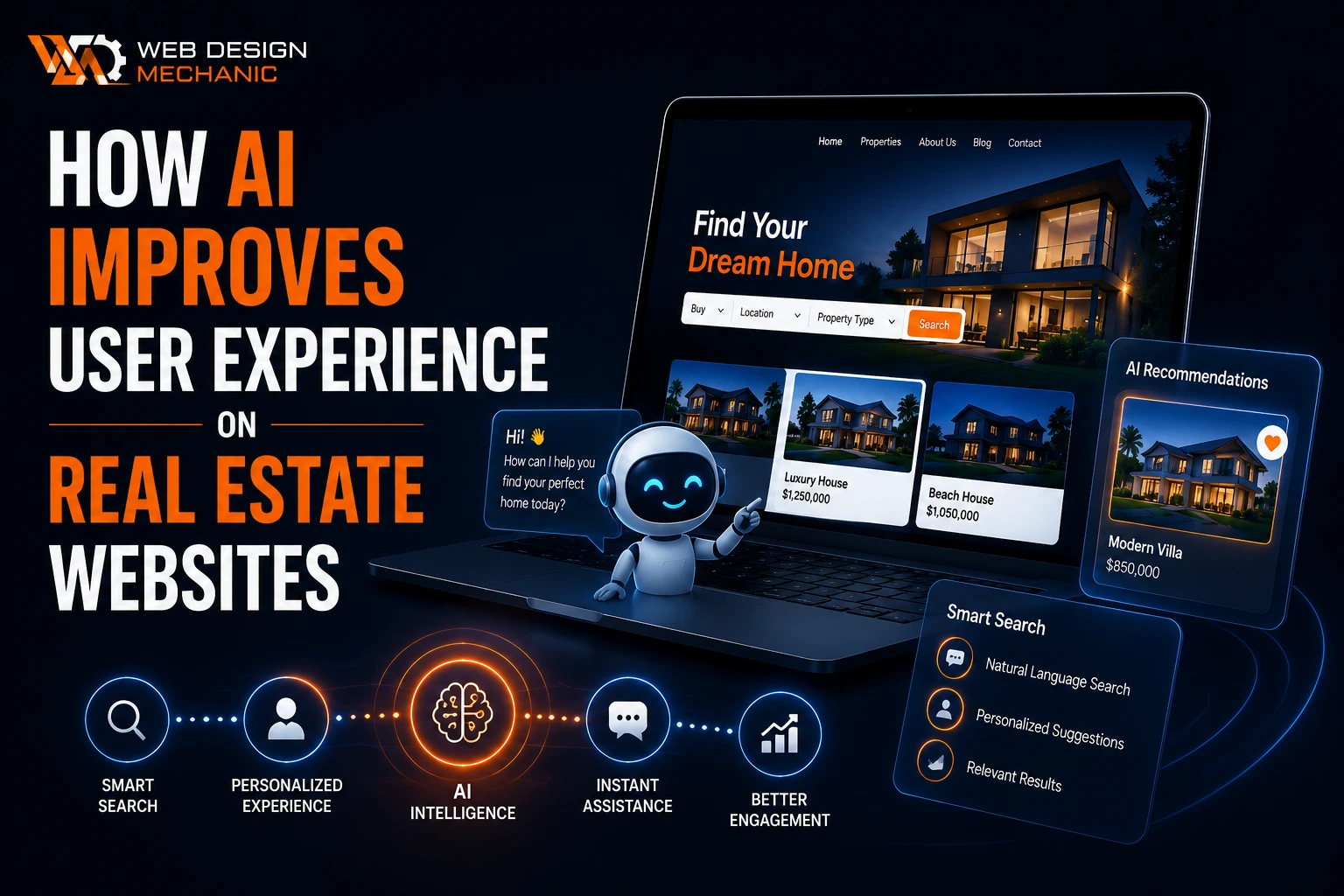
This is arguably the most impactful application of AI for real estate websites. Rather than showing every visitor the same generic listings, AI algorithms analyze behavior, what a user has clicked on, how long they spent on each listing, what they searched for, and use that data to surface properties they’re more likely to be interested in.
It works similarly to how streaming platforms recommend content, but applied to home search. A buyer who keeps clicking on properties with large kitchens and open floor plans will start seeing more of those automatically. This kind of real estate website personalization AI dramatically reduces the friction of property discovery and keeps visitors engaged longer.
Intelligent Search Functionality
Standard search boxes on real estate websites are functional but limited. AI-powered search understands natural language queries. Instead of requiring a visitor to set filters manually, they can type “three-bedroom homes near good schools under $500k” and get relevant results. This makes the search experience far more intuitive, especially for first-time buyers who may not know exactly what filters to apply.
Behavioral Adaptation
AI doesn’t just personalize based on stated preferences; it adapts based on observed behavior. If a visitor consistently skips over condos and spends time on single-family homes, the site learns this and adjusts what it shows. This kind of dynamic adaptation is a cornerstone of AI user experience for real estate websites because it meets users where they are without requiring them to do extra work.
AI-Powered Features That Directly Improve Real Estate UX
Virtual Tours and AI-Enhanced Media
AI is improving how properties are presented visually. Automated image enhancement ensures listing photos look their best. AI can also help generate virtual staging, showing an empty property furnished without the cost of physical staging. These tools improve the visual experience significantly, which matters because most buyers make decisions about whether to visit a property based on what they see online first.
Chatbots and Conversational Interfaces
We’ve covered chatbots in detail separately, but within the UX context, they play a key role in making the website feel responsive and alive. When a visitor has a question, they don’t have to search through the site for an answer; they can just ask. That immediate, conversational access to information is a major UX improvement over static content.
If you’re curious about specific chatbot functionality in the lead generation context, our related content explores that in depth, but from a pure UX standpoint, the value is in reducing friction and making information instantly accessible.
AI-Driven Map and Neighborhood Insights
Modern real estate websites powered by AI can offer rich neighborhood data, school ratings, walkability scores, nearby amenities, and crime statistics dynamically tied to listings. Presenting this information contextually (right there on the listing page, not buried in a separate tab) improves the decision-making process for buyers and creates a richer, more useful experience.
Improving Navigation and Information Architecture With AI
One area that’s often overlooked when discussing real estate website UX AI is navigation. How do visitors move through your site? Are they finding what they need efficiently, or are they bouncing because the journey is confusing?
AI tools, particularly session recording and heatmap analytics combined with AI analysis, can identify exactly where visitors struggle. Are people repeatedly clicking on something that isn’t a link? Are they landing on a page and immediately leaving? AI can surface these insights faster and more accurately than manual analysis.
That data then informs design decisions, restructuring menus, improving internal linking, simplifying search flows, all of which directly improve UX. When we’re building or redesigning a real estate website, this kind of data-informed approach is fundamental to how we work. You can explore what goes into a well-structured site in our guide on essential real estate website features.
Page Speed and Performance
UX isn’t only about what visitors see and click; it’s also about how fast everything loads. AI is increasingly used in web performance optimization, from predictive caching (preloading pages a user is likely to visit next based on their behavior) to image compression that dynamically adjusts quality based on the user’s device and connection speed.
These behind-the-scenes improvements have a direct impact on user experience. A site that loads in two seconds delivers a fundamentally different experience than one that takes six. And in real estate, where visitors often browse dozens of listings, slow load times are a significant UX problem.
If you’re building a new site or planning a redesign, understanding the technical decisions involved is important. Learn how to build a real estate website and take the key considerations that affect both performance and UX.
Personalization Beyond Listings
AI personalization on real estate websites extends beyond just which properties are shown. It can also personalize:
Content and resources: A first-time buyer sees educational content about mortgages and the buying process. An experienced investor sees market analysis and ROI calculators.
CTAs and offers: The calls to action displayed can adapt based on where someone is in their journey. Someone early in the research phase sees “Download our neighborhood guide,” while someone who’s viewed ten listings sees “Schedule a viewing today.”
Email follow-up sequences: When combined with your CRM, AI can trigger personalized follow-up emails based on what a visitor engaged with on your site, making every touchpoint feel relevant rather than generic.
This level of personalization is what separates a modern, high-performing real estate website from a standard one. It’s also a significant part of how we approach professional website design for our real estate clients.
The Connection Between UX and SEO
Better user experience and better search rankings aren’t separate goals; they reinforce each other. Google’s ranking algorithms increasingly prioritize UX signals: time on site, bounce rate, page experience metrics. A site that engages visitors with AI-powered personalization naturally improves these signals.
Similarly, a site with fast load times, intuitive navigation, and relevant content is rewarded both by visitors who stay and convert and by search engines that recognize these quality signals. Investing in AI in real estate UX design isn’t just about the visitor experience; it’s also a long-term SEO play.
If you want to understand how to structure your website for both user experience and search performance, at Web Design Mechanic, we offer a good starting point for understanding our approach.
Practical Steps to Improve Real Estate Website UX With AI
Here’s where to start if you want to meaningfully improve UX on your real estate website using AI:
Audit your current UX: Use heatmaps and session recordings to understand where visitors struggle. Tools like Hotjar or Microsoft Clarity provide this data.
Implement personalized listing recommendations: Most modern real estate website platforms support this. If yours doesn’t, it may be time to consider upgrading.
Add AI-powered search: Natural language search significantly improves usability for all visitor types.
Integrate a chatbot: Even a well-configured basic chatbot reduces friction for visitors who have questions.
Review your site’s cost and value: Understanding the real cost of a real estate website can help you make informed decisions about where to invest in AI-powered improvements.
Conclusion
AI is transforming how people search for and interact with real estate websites. By delivering personalized property recommendations, intelligent search capabilities, instant assistance, and seamless navigation, AI creates a faster and more engaging experience for every visitor. These improvements not only help users find the right property more efficiently but also encourage longer site visits, stronger engagement, and higher conversion rates.
As buyer expectations continue to rise, adopting AI is becoming less of a competitive advantage and more of a necessity. By implementing the right AI-powered features while maintaining a user-first approach, we can create real estate websites that are more intuitive, responsive, and effective at turning visitors into qualified leads.